Chinese Eggplant Garlic Recipe
This post contains affiliate links. As an Amazon Associate I earn from qualifying purchases.
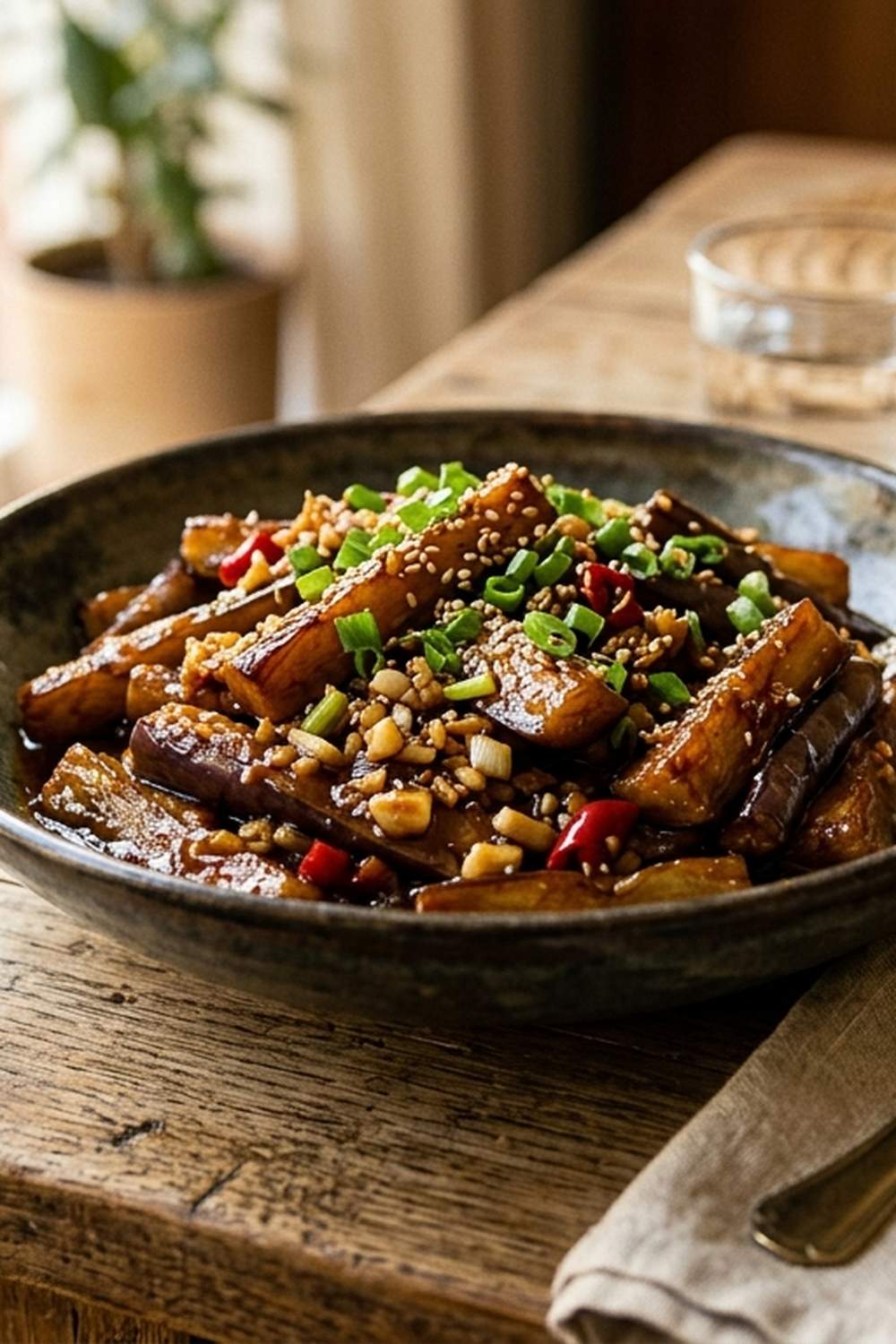
Ten ounces of eggplant. A handful of garlic cloves. A whisper of ginger. A splash of soy. That’s all it takes to create something transcendent—a dish that tastes like it’s been simmering for hours, even though your stovetop work spans mere minutes. No long shopping lists. No complicated techniques borrowed from restaurants you’ll never visit. Just five core ingredients working in perfect harmony, the way my grandmother taught me that real cooking should be.
I still remember watching her prepare something similar on a humid August afternoon in her small kitchen. She didn’t own fancy equipment or exotic spice collections. What she had was intention—the understanding that when you respect your ingredients and give them space to breathe, magic happens. This Chinese eggplant with garlic is exactly that kind of magic. It’s the kind of recipe that makes people ask for seconds, then thirds, then the recipe itself.
Chinese Eggplant With Garlic: Five Ingredients That Prove Simple Is Best
I’ve spent years as a registered dietitian studying nutrition science, formula optimization, and ingredient synergy. But somewhere along the way, I realized that the most nourishing meals aren’t the most complicated ones. They’re the ones where each component has a clear job—where nothing competes for attention, and everything contributes to something greater than itself.
This particular dish taught me that constraint breeds creativity. When I first committed to making this with only five essential ingredients, I thought I was limiting myself. Instead, I discovered I was liberating myself. No decision paralysis. No ingredient waste. No burnt edges from overcrowded pans. Just pure, focused cooking where technique and timing become everything.
That’s the philosophy I want to share with you today. Because whether you’re a busy parent, a college student on a tight budget, or someone who simply wants to cook like their grandmother once did, this recipe proves that complexity isn’t required for excellence.
Why Five Ingredients Is Actually an Advantage
- Your shopping trip takes minutes, not hours – I can source these ingredients from any market in Worcester—whether that’s our local farmers market on summer Saturdays or the corner grocer two blocks away. Less money spent, less packaging waste, less decision fatigue before you even start cooking.
- Each ingredient becomes the star – When you’re working with eggplant, garlic, ginger, soy sauce, and neutral oil, there’s nowhere to hide. Every element must be fresh, every technique must be precise. You develop real skills instead of relying on exotic ingredients to do the heavy lifting.
- You’ll actually make this again and again – When a recipe becomes automatic, when you know exactly what to expect, when you can execute it perfectly even on exhausting Wednesday evenings, that’s when it becomes part of your permanent kitchen rotation. That’s when it becomes a tradition.
Choosing Your Five Ingredients Wisely
I didn’t arrive at this ingredient list through accident. Every single component earned its place through function and flavor. When you’re working with minimal ingredients, you can’t afford passengers—every addition must justify its presence.
The eggplant serves as your canvas: tender, absorbent, capable of developing those deep caramelized edges that make your mouth water. The garlic provides punch and complexity—those three cloves deliver more flavor than you’d expect, especially when minced fine and bloomed in hot oil. Fresh ginger adds warmth and subtle heat, a grounding note that prevents the dish from becoming one-dimensional. Soy sauce (both light and dark) contributes umami depth and saltiness without requiring additional seasonings. And neutral oil? That’s your vehicle for heat distribution and the foundation of proper browning.
This is what I call the maximum flavor strategy. Rather than spreading yourself thin across ten ingredients, you focus your energy on quality versions of five essential components, then cook them with intention and respect for timing.
The Five Ingredients
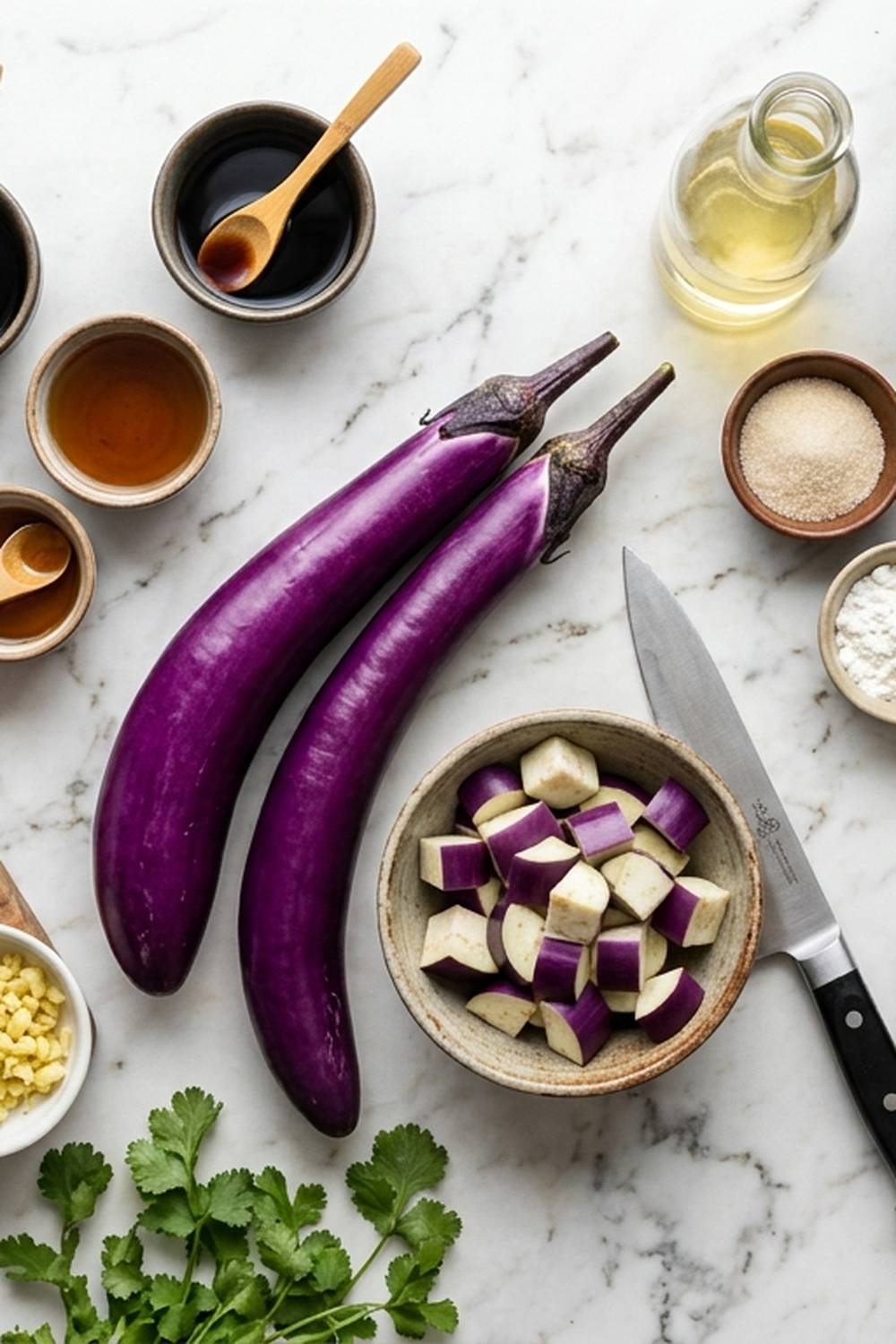
Let me walk you through exactly why each ingredient made the cut, and what you should look for when shopping. This is where your success begins—before you ever turn on the stove.
- 10 ounces Chinese eggplant, chopped into bite-sized pieces (approximately 2 small eggplants; look for firm specimens with glossy skin, typically found near other Asian vegetables at your market)
- 3 cloves garlic, minced finely (fresh, pungent, the foundation of your aromatic base)
- 2½ tablespoons neutral oil such as peanut or vegetable oil (for proper heat distribution and the development of those critical caramelized edges)
- 3 tablespoons combined soy sauce (1 tablespoon light soy sauce, ½ teaspoon dark soy sauce, plus 1 tablespoon water and 2 teaspoons sugar mixed together for your finishing sauce)
- 1 teaspoon fresh ginger, minced (provides warming depth and digestive support that my grandmother always emphasized)
Notice I’ve simplified the ingredient list from the traditional approach. You don’t need separate cornstarch measurements or additional salts if you work methodically. This version trusts your technique rather than relying on thickeners.
How to Make Chinese Eggplant With Garlic in Five Simple Steps
The elegance of simplicity lives in execution. With only five ingredients, every technique matters more. Your knife skills matter. Your heat control matters. Your timing matters. This isn’t a recipe where you can multitask through three other dishes while cooking—but that’s actually liberating. For the fifteen minutes this takes, this is your sole focus. This is meditation in motion.
Step 1: Prepare Your Eggplant Through Proper Moisture Management
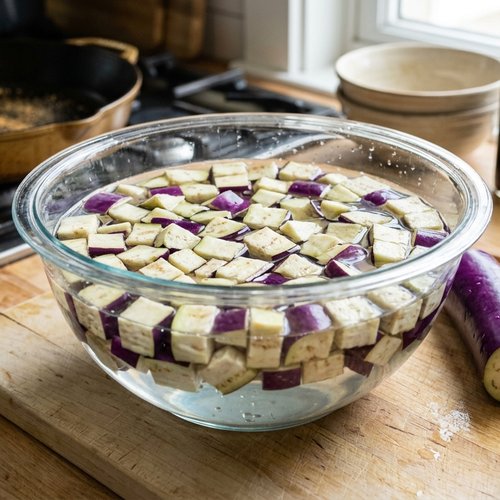
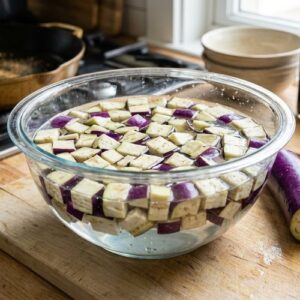
Cut your eggplant into uniform bite-sized pieces—roughly three-quarter inch cubes work beautifully. Place them in a large bowl and cover with cool water, then add one teaspoon of salt. This seems counterintuitive, but here’s the science: eggplant contains compounds that can taste slightly bitter, and they hold water that prevents proper browning. By submerging the pieces under a weighted lid (I use a smaller bowl placed directly on top) for exactly fifteen minutes, you’re drawing out moisture and softening those compounds.
After fifteen minutes, drain thoroughly in a colander, then pat each piece dry with paper towels. This step is non-negotiable. Moisture is the enemy of caramelization. When you place wet eggplant into hot oil, you get steaming instead of browning. You want browning. You want those deep mahogany edges.
Step 2: Create Your Finishing Sauce While the Eggplant Rests
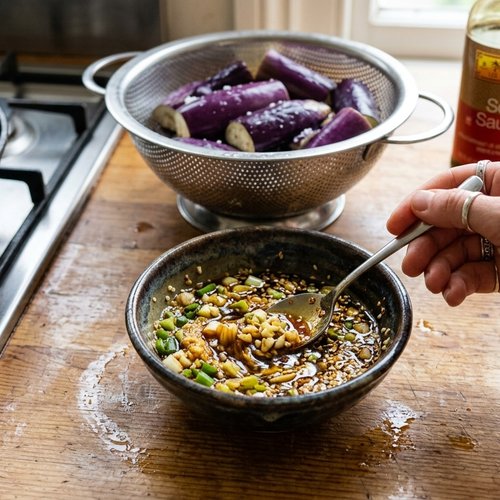
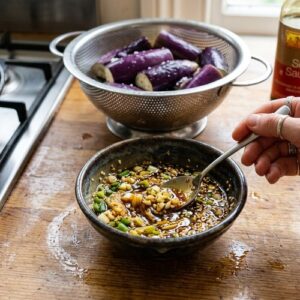
While your eggplant is sitting in its salt bath, combine your sauce components in a small bowl: one tablespoon light soy sauce, half a teaspoon dark soy sauce (which adds color and deeper umami complexity), one tablespoon of water, and two teaspoons of sugar. Stir these together thoroughly so the sugar begins dissolving. Keep this mixture close to your cooking station—you’ll need it at the exact right moment, and timing matters.
The light soy provides saltiness and brightness. The dark soy adds visual depth and a slightly more complex mineral note. The water softens the intensity while the sugar balances the saltiness and brings out the eggplant’s natural sweetness. This is balance in liquid form.
Step 3: Heat Your Oil and Begin the Browning Process
Add two tablespoons of your neutral oil to a large nonstick skillet and bring it to medium-high heat. You want the oil shimmering and just barely smoking—this is roughly 375°F if you have a thermometer, though you can judge by the oil’s movement and the sound it makes. The eggplant should sizzle immediately when it hits the pan.
Spread your dried eggplant pieces across the bottom of the skillet in a single layer, without overlapping. This is critical. Crowded pans create steam, not browning. Work in batches if necessary—I’d rather spend an extra five minutes and achieve perfect color than rush and end up with pale, mushy eggplant.
Let the eggplant sit undisturbed for three to four minutes on the first side. You’re listening for the gentle sizzle to continue, watching for the bottom surfaces to turn golden-brown and slightly charred. Then, without fussing with each piece, shake the pan or use a spatula to turn everything over. Another three to four minutes on the opposite side. Total browning time runs eight to ten minutes, depending on your eggplant’s size and your stove’s personality.
If your skillet begins smoking heavily, reduce heat slightly to medium. Eggplant can burn, and burnt tastes bitter. You want deep caramelization, not charred destruction.
Step 4: Bloom Your Aromatics in the Remaining Oil
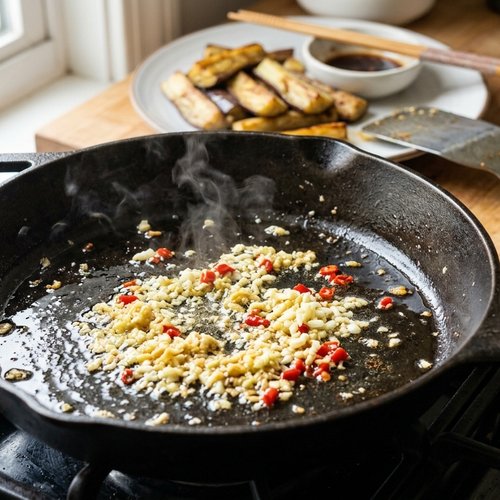
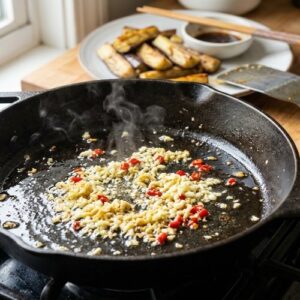
Once your eggplant achieves that beautiful color, transfer it to a clean plate. Add the remaining half tablespoon of oil to your skillet (it should still have some residual heat), then immediately add your minced ginger and minced garlic. You’ll have maybe fifteen seconds before things become urgent—this is where you need presence.
Stir constantly for thirty to forty-five seconds until the garlic and ginger release their fragrance into the oil. You’re awakening essential oils and compounds that will define this dish’s personality. The smell should be unmistakably warm and complex. Don’t let the garlic brown—burnt garlic tastes acrid and bitter. You want it softened and fragrant, not charred.
Step 5: Return the Eggplant and Finish With Your Sauce
Return all your browned eggplant to the skillet with the garlic and ginger. Give the sauce mixture a final stir to ensure the sugar has fully dissolved, then pour it directly over everything. Immediately begin stirring constantly—this takes about one minute. The liquid will reduce slightly, thicken, and coat every piece of eggplant in a glossy, mahogany finish.
Transfer everything to a serving plate and present it while still warm. The sauce will continue to coat the eggplant, deepening in flavor as it sits for a few minutes.
The Optional Sixth Ingredient (If You Want to Elevate)
If your palate leans toward heat or you want to acknowledge the traditional preparation more directly, consider adding half a teaspoon of white pepper or a pinch of red pepper flakes to your finished dish. White pepper adds gentle heat and a subtle earthiness without overwhelming the other flavors, while crushed red pepper flakes provide visible texture and straightforward spice.
Alternatively, a few drops of sesame oil drizzled over the finished dish adds richness and a toasted note that elevates this from “simple side” to “showstopping component.” But here’s the thing—you don’t need it. The five-ingredient version stands entirely on its own merits.
Chinese Eggplant With Garlic: Five Ingredient Variations
- Spicy Sichuan Version – Replace the fresh ginger with Sichuan peppercorns (¼ teaspoon, toasted and ground) and add a pinch of dried chili flakes to create that distinctive numbing-heat sensation. This shifts the flavor profile toward Sichuan cuisine while maintaining the minimal ingredient philosophy.
- Sesame-Forward Variation – Reduce the soy sauce by half a tablespoon and add a full tablespoon of sesame oil to your browning phase. Toast one tablespoon of sesame seeds separately in a dry pan, then scatter them over the finished dish for textural contrast and nutty depth.
- Vinegar-Balanced Version – Add one teaspoon of black vinegar or rice vinegar to your sauce mixture, reducing the sugar to one teaspoon. This creates a sweet-sour-savory profile that feels brighter and more acidic, especially beautiful served alongside rich rice dishes.
Can I Store Chinese Eggplant With Garlic?
Absolutely, and this is where the recipe becomes even more practical for real life. Store your finished eggplant in an airtight container in the refrigerator for up to four days. The flavors actually deepen as it sits, becoming more integrated and complex.
To reheat, either bring it back to room temperature and serve it at ambient temperature (which I actually prefer—the flavors open up without the distraction of heat), or warm it gently in a skillet over low heat with a splash of water, stirring occasionally until heated through. Don’t microwave, which can create uneven heating and mushy textures.
The eggplant doesn’t freeze particularly well due to its delicate cell structure, so I recommend treating this as a refrigerator-to-table recipe rather than a freezer candidate.
Expert’s Nutritional Insight: Why This Dish Deserves a Place at Your Table
As a registered dietitian, I’m constantly aware of how food functions in the body beyond mere calories. This dish checks several important boxes that modern nutrition science now emphasizes.
Eggplant contains nasunin, a powerful anthocyanin antioxidant concentrated in the skin. This compound supports cognitive function and cellular protection—it’s one reason why purple vegetables have become increasingly emphasized in longevity research. When you brown eggplant properly, you’re not destroying these compounds; you’re making them more bioavailable.
Fresh garlic contains allicin, a sulfur compound that emerges when you cut or mince the cloves. This compound has documented benefits for immune function and cardiovascular health. The key is consuming it relatively fresh—the longer it sits after mincing, the more of those beneficial compounds degrade.
Ginger aids digestive function and provides gingerol compounds that support inflammation management. My grandmother always insisted that ginger settled the stomach after rich meals, and modern research increasingly validates her intuition.
According to USDA data, one serving (approximately 5 ounces) of this prepared dish contains roughly 95 calories, 4 grams of fat (mostly from the neutral oil, which is heart-healthy), 13 grams of carbohydrates, and 2 grams of protein. The sodium content comes entirely from soy sauce at approximately 450 milligrams per serving—notable if you’re managing sodium intake, though moderate for typical American consumption patterns.
Make-Ahead Guide: Meal Prep Strategy for Busy Weeknights
Here’s where this recipe transforms from simple dinner to strategic meal prep component. You can prepare the eggplant through step one (the saltwater soak and drying) up to twelve hours in advance. Store your dried eggplant pieces in an airtight container in the refrigerator—they’ll actually benefit from the time, becoming slightly firmer and more able to brown.
Prepare your sauce mixture (step two) up to three days in advance in a small container. Mince your garlic and ginger up to eight hours ahead, storing them in separate small containers. This isn’t laziness; this is strategic preparation that makes the actual cooking—the part that requires your full attention—take mere minutes.
On cooking day, you’re essentially executing steps three through five: browning the eggplant, blooming the aromatics, combining everything with sauce. That’s fifteen minutes of actual stovetop time, start to finish. The preparation work has already happened, invisibly, during your calmer moments earlier in the week.
Common Mistakes to Avoid (So You Don’t Make Them)
Mistake One: Skipping the Moisture-Removal Step – I understand the temptation. The saltwater soak feels unnecessary, like extra work. But this step genuinely transforms your outcome. Eggplant that hasn’t had moisture drawn out will steam instead of brown, turning mushy and pale. Give it the fifteen minutes. Your future self will thank you.
Mistake Two: Overcrowding Your Pan – This is where impatience ruins everything. You have a specific amount of eggplant and you want it finished quickly, so you pile it high and cover the pan. Instead, you get steaming, sticking, uneven cooking. Work in batches if needed. The extra five minutes creates exponentially better results.
Mistake Three: Adding Sauce Too Early – Cooking your sauce at high heat causes the sugar to crystallize and the soy to break down, creating a bitter rather than balanced flavor. Add your sauce at the very end, right before serving, when everything is off high heat and the flavors can meld gently. This timing detail separates mediocre versions from excellent ones.
Mistake Four: Not Tasting and Adjusting – Even with precise measurements, every stove is different, every eggplant holds water differently, every soy sauce brand tastes slightly different. Taste your finished dish before serving. Need more saltiness? Add a splash more soy sauce. Need brightness? A few drops of vinegar or lemon juice. This is how you move from following a recipe to owning it.
Seasonal Variations: How to Adapt This Recipe Throughout the Year
Summer Version – When you have access to peak farmer’s market eggplant (June through August), source the most beautiful specimens available. These tend to be smaller, with thinner skin and fewer seeds, requiring slightly shorter browning time. Add a pinch of fresh basil or Thai basil to the finished dish for seasonal brightness that complements warm-weather eating.
Fall Adaptation – As eggplant becomes slightly larger and denser heading into autumn, increase your browning time by one to two minutes per side. Add ¼ teaspoon of five-spice powder (which contains warming cinnamon, clove, and star anise) to your sauce mixture for seasonal depth that feels cozy without becoming heavy.
Winter Approach – Winter eggplant tends toward larger specimens with more developed seeds. Cut these into slightly smaller pieces to account for longer cooking time. Add ½ teaspoon of dark sesame oil to your finished dish for the warmth and richness that makes sense during colder months. Serve alongside congee or rice porridge for maximum comfort.
Spring Treatment – When spring eggplant arrives (which varies by region but generally runs April through early June), celebrate its relative delicacy by serving it at room temperature as a vegetable course before your main protein. The lighter preparation complements spring’s forward-looking energy.
What to Serve With Chinese Eggplant With Garlic?
The beauty of this dish is its flexibility. It functions equally well as a vegetable side, a light main course over rice, or a component in a larger meal. The five-ingredient philosophy doesn’t stop at your eggplant—it extends to everything surrounding it.
Steamed white rice is the most obvious pairing, and for good reason. The plain, slightly sweet rice provides textural contrast while the sauce clings beautifully to each grain. Brown rice works too, offering more fiber and a nuttier flavor that actually enhances the garlic and ginger notes.
Chow mein or fresh wheat noodles create a heartier meal, transforming your eggplant into a noodle sauce situation. This is where the five-ingredient simplicity allows your focus to shift to accompanying proteins if desired—perhaps some steamed shrimp or quickly panfried tofu from your vegetarian baozi recipe preparations.
If you’re building a more elaborate table (the way my grandmother always did), pair this with something protein-forward like the Asian beef shank recipe for a more complete meal, or keep it vegetarian-forward and simple. The eggplant’s richness means it doesn’t need accompaniment to feel complete.
- Steamed jasmine rice – keeps the minimal spirit while providing perfect sauce-absorption and gentle aromatics that complement rather than compete
- Simple bok choy with garlic – prepared using the exact same browning technique with just three ingredients (bok choy, garlic, neutral oil) to echo the main dish’s philosophy
- Cucumber salad with rice vinegar – provides cooling contrast and brightness that balances the eggplant’s richness without adding complexity
- Steamed buns – whether you use your bao recipe filling or keep them plain, buns offer textural variety while staying in the minimal philosophy
Frequently Asked Questions
Can I use regular eggplant instead of Chinese eggplant?
You can, but it’s not ideal. Regular globe eggplant (the larger, rounder variety) contains more seeds and holds more water, requiring longer cooking time and more aggressive browning. If that’s what you have available, cut it into smaller pieces, increase your browning time to twelve to fifteen minutes, and consider removing some seeds if the eggplant is particularly large. The result will be slightly different in texture but still delicious—the fundamental technique remains sound.
What if I can’t find dark soy sauce?
Use all light soy sauce instead, increasing the amount to 1½ tablespoons total and adding an extra pinch of sugar to maintain flavor balance. The result will be lighter in color and slightly less complex, but still completely functional. Dark soy sauce is mostly about color and subtle mineral depth—you won’t ruin anything by working without it. It’s a refinement, not a requirement.
Is this recipe naturally vegan?
Yes, completely. Every single ingredient is plant-based. Soy sauce, eggplant, garlic, ginger, and neutral oil form a fully vegan dish that needs no modification. This is one of those recipes where dietary restriction and ingredient simplicity align beautifully.
How much salt should I add at the table?
Virtually none. The soy sauce provides enough sodium that additional salt typically overshoots the mark. Taste your finished dish first—I find most people don’t need to add anything. If it tastes slightly flat, try a drop of vinegar or sesame oil before reaching for salt. Those additions often address the perceived deficit more elegantly than additional sodium.
Can I make this in a wok instead of a skillet?
Absolutely. A carbon steel or well-seasoned cast iron wok is actually traditional for this preparation. The key advantage is the sloped sides that allow easier tossing and moving ingredients around. Follow the exact same technique—proper heat, single-layer browning, no crowding. The results will be virtually identical, potentially slightly superior because the wok’s shape facilitates better heat distribution.
More Five-Ingredient Recipes to Expand Your Kitchen Repertoire
- BBQ Chinese Pork Recipe – proves that restraint in ingredients creates deeper, more memorable flavors when combined with patience and proper technique
- Baked Pork Chop Rice Recipe – demonstrates how five simple ingredients plus time in the oven can create one-dish meals that taste like they required hours of active cooking
- Easy Frozen Chicken Breast Recipe – shows how minimal ingredients and proper thawing technique yield restaurant-quality results from ingredients you already have on hand
The Power of Restraint in a World of Excess
My grandmother never owned a cookbook, never consulted the internet, never second-guessed her ingredient choices. She cooked from understanding—deep, embodied knowledge of how flavors work together, how heat transforms texture, how patience creates magic. She cooked with what was available, what was seasonal, what her budget allowed.
This Chinese eggplant with garlic is my attempt to honor that approach while bringing it into your modern kitchen, your busy life, your real-world constraints and desires. It’s proof that you don’t need exotic ingredients or complicated techniques to create something worth remembering. You need attention. You need intention. You need to show up and be fully present for the fifteen minutes it takes to transform five humble ingredients into something your family will request again and again.
That’s where real nourishment begins—not in the nutritional data or the technique guides, but in the moment when someone tastes what you’ve made and asks for more. When they want to know how you did it. When they realize that simple, done well, beats complicated every single time.
I hope this recipe becomes part of your rotation, your tradition, your story. I hope you make it enough times that you stop consulting measurements and start trusting your instincts. I hope your kitchen starts to smell like caramelized eggplant and blooming garlic on regular weeknight evenings.
That’s when you know it’s working.

Chinese Eggplant Garlic Recipe
Method
- Cut your eggplant into uniform bite-sized pieces—roughly three-quarter inch cubes work beautifully. Place them in a large bowl and cover with cool water, then add one teaspoon of salt. This seems counterintuitive, but here's the science: eggplant contains compounds that can taste slightly bitter, and they hold water that prevents proper browning. By submerging the pieces under a weighted lid (I use a smaller bowl placed directly on top) for exactly fifteen minutes, you're drawing out moisture and softening those compounds. After fifteen minutes, drain thoroughly in a colander, then pat each piece dry with paper towels. This step is non-negotiable. Moisture is the enemy of caramelization. When you place wet eggplant into hot oil, you get steaming instead of browning. You want browning. You want those deep mahogany edges.
- While your eggplant is sitting in its salt bath, combine your sauce components in a small bowl: one tablespoon light soy sauce, half a teaspoon dark soy sauce (which adds color and deeper umami complexity), one tablespoon of water, and two teaspoons of sugar. Stir these together thoroughly so the sugar begins dissolving. Keep this mixture close to your cooking station—you'll need it at the exact right moment, and timing matters. The light soy provides saltiness and brightness. The dark soy adds visual depth and a slightly more complex mineral note. The water softens the intensity while the sugar balances the saltiness and brings out the eggplant's natural sweetness. This is balance in liquid form.
- Add two tablespoons of your neutral oil to a large nonstick skillet and bring it to medium-high heat. You want the oil shimmering and just barely smoking—this is roughly 375°F if you have a thermometer, though you can judge by the oil's movement and the sound it makes. The eggplant should sizzle immediately when it hits the pan. Spread your dried eggplant pieces across the bottom of the skillet in a single layer, without overlapping. This is critical. Crowded pans create steam, not browning. Work in batches if necessary—I'd rather spend an extra five minutes and achieve perfect color than rush and end up with pale, mushy eggplant. Let the eggplant sit undisturbed for three to four minutes on the first side. You're listening for the gentle sizzle to continue, watching for the bottom surfaces to turn golden-brown and slightly charred. Then, without fussing with each piece, shake the pan or use a spatula to turn everything over. Another three to four minutes on the opposite side. Total browning time runs eight to ten minutes, depending on your eggplant's size and your stove's personality. If your skillet begins smoking heavily, reduce heat slightly to medium. Eggplant can burn, and burnt tastes bitter. You want deep caramelization, not charred destruction.
- Once your eggplant achieves that beautiful color, transfer it to a clean plate. Add the remaining half tablespoon of oil to your skillet (it should still have some residual heat), then immediately add your minced ginger and minced garlic. You'll have maybe fifteen seconds before things become urgent—this is where you need presence. Stir constantly for thirty to forty-five seconds until the garlic and ginger release their fragrance into the oil. You're awakening essential oils and compounds that will define this dish's personality. The smell should be unmistakably warm and complex. Don't let the garlic brown—burnt garlic tastes acrid and bitter. You want it softened and fragrant, not charred.
- Return all your browned eggplant to the skillet with the garlic and ginger. Give the sauce mixture a final stir to ensure the sugar has fully dissolved, then pour it directly over everything. Immediately begin stirring constantly—this takes about one minute. The liquid will reduce slightly, thicken, and coat every piece of eggplant in a glossy, mahogany finish. Transfer everything to a serving plate and present it while still warm. The sauce will continue to coat the eggplant, deepening in flavor as it sits for a few minutes.
With warmth and intention,
Willie Regan, MS, RD