Chicken Eggplant Chinese Recipe
This post contains affiliate links. As an Amazon Associate I earn from qualifying purchases.
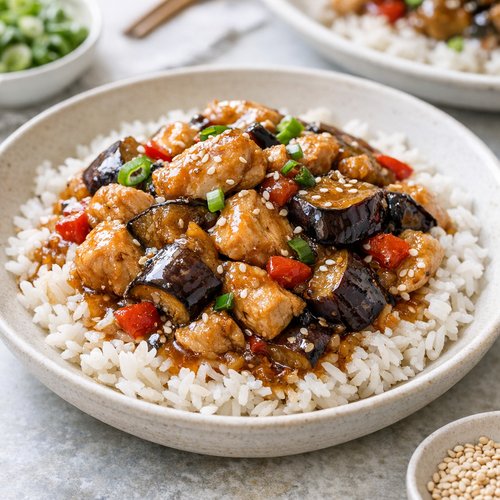
If you’ve always wanted to make a chicken eggplant stir-fry but felt intimidated by the wok, the timing, or the unfamiliar ingredients, this is your starting point. I’m going to walk you through this dish exactly as my grandmother taught me—slowly, with patience, and with complete reassurance that you’re going to nail it. This recipe comes from watching her transform purple eggplant and tender chicken into something so comforting, so balanced, that it reminded me why I became a dietitian. You don’t need restaurant skills or fancy equipment. You just need curiosity and about 30 minutes. If you love the kind of food that tastes like home, try our BBQ Chinese Pork Recipe after you master this one.
How to Make Chicken Eggplant Chinese Recipe for the First Time (You’ve Got This)
I still remember the afternoon my grandmother first taught me this dish. I was maybe fourteen, standing on a stool beside her in her small kitchen in Worcester, watching her cut eggplant at an angle with such confidence that I thought it was some kind of secret technique. She smiled and said, “Willie, the angle doesn’t matter—what matters is that you’re paying attention.” That stuck with me. I was terrified I’d ruin something, mess up the timing, or over-cook the chicken. But she made it clear: this dish was forgiving if you treated it with respect.
That’s what I want you to feel as you make this. Respect for the ingredients, patience with the process, and trust that your first attempt is going to turn out beautifully. My grandmother’s hands moved slowly through that kitchen. She didn’t rush. Neither should you.
What to Expect Before You Start
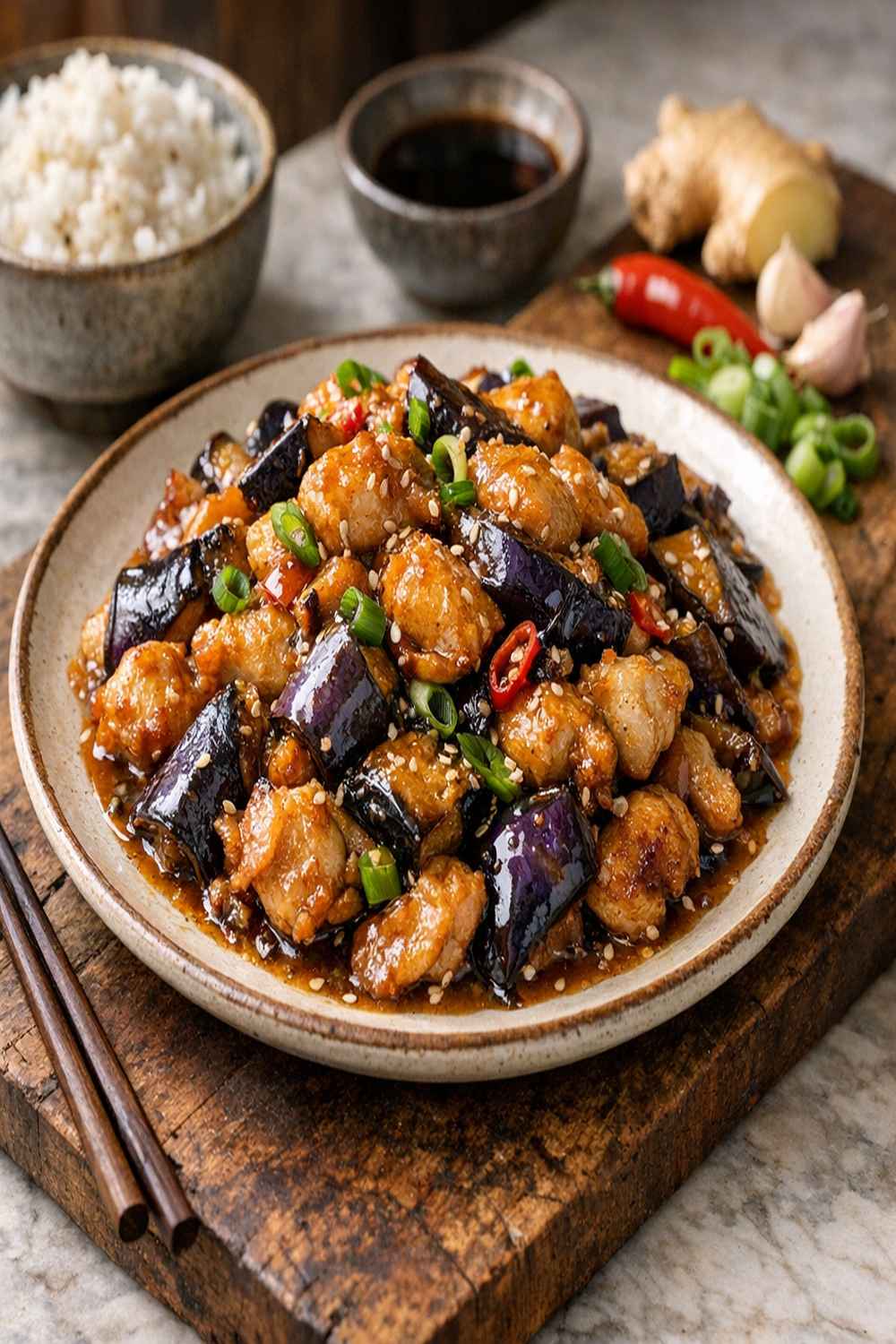
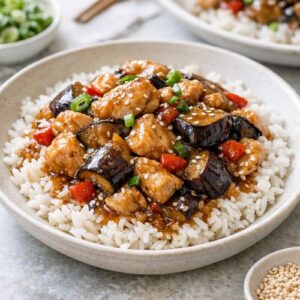
Let me set realistic expectations so there are no surprises. This dish takes about 30-35 minutes total, with most of that being hands-on time. The difficulty is beginner to intermediate—not because it’s complicated, but because you’re learning to manage heat, timing, and ingredient prep at the same time. Here’s what success actually looks like: tender chicken, silky eggplant with just a light golden edge, and a glaze that coats everything without being heavy or overly thick.
- The prep is longer than the cooking – Chopping and measuring takes about 15 minutes. The actual cooking happens fast (about 12-15 minutes). This is intentional and makes you feel in control.
- High heat is your friend, not your enemy – If you’re worried about burning things, don’t. The high heat creates flavor. I’ll show you exactly what to look for so you know you’re not overdoing it.
- Your first batch might look messier than you’d like – That’s completely normal. By your second or third time, your hands will know the rhythm. The taste won’t change one bit.
Equipment You’ll Need (And What You Can Skip)
Here’s what I recommend you gather before you start. None of this is fancy, and I’ll give you budget alternatives for anything that feels out of reach. My grandmother never had most of these tools—she made magic with what she had. That said, having the right tool makes learning easier.
- A large wok or wide skillet (12-14 inches) – A wok distributes heat evenly and gives you space to toss ingredients without spilling. If you don’t have one, a large skillet works perfectly fine. Cost doesn’t matter; even a $15 wok from an Asian market will serve you beautifully for years.
- A sharp chef’s knife (8-inch blade) – You’ll be chopping a lot of vegetables. A sharp knife is safer and faster. Borrow one from a friend if you need to; this single tool changes everything about cooking confidence.
- Two small bowls for mise en place (prepped ingredients) – You’ll keep your sauce in one and your chopped aromatics in another. Any bowl works. This keeps you organized and prevents the panic of forgetting an ingredient mid-cook.
- A microwave-safe bowl – For softening the eggplant. You could use a pot of boiling water instead, but the microwave is faster and less messy for a beginner.
- Measuring spoons and a liquid measuring cup – Accuracy matters for the sauce. Don’t eyeball this part on your first try.
- Paper towels – For patting eggplant dry and general cleanup. Essential, not optional.
- A whisk or fork – For mixing the sauce. A fork works just as well as a whisk.
The Ingredients – A Beginner’s Shopping Guide
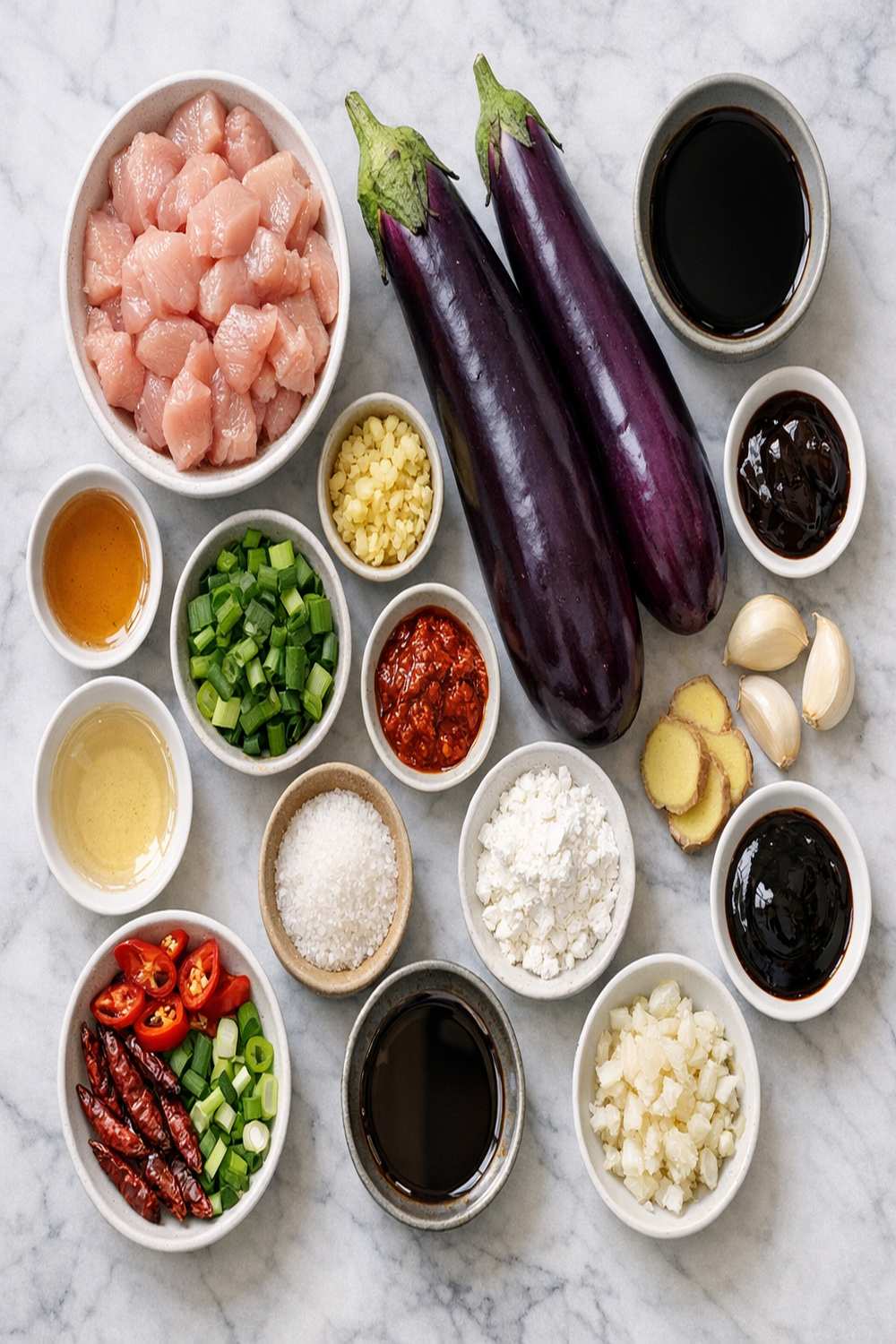
Let me walk you through where to find everything and what to look for when you’re shopping. The beautiful part about this dish is that most ingredients are easy to find at any grocery store, and the specialty items (like sambal oelek) are getting easier to locate every year. I’ve also included notes about quality and substitutions so you’re never stuck.
For the Protein and Vegetables
- 1 shallot, medium-sized (sweeter than onion, milder than garlic—usually sold near the onions)
- 1 tablespoon fresh ginger, approximately 1 inch of a ginger root (peel with a spoon, not a knife, for less waste)
- 2 green onions (scallions), fresh (the white and light green parts add bite; the dark green tops add color and freshness)
- 1 cup shiitake mushrooms, fresh (these have an earthy depth; cremini mushrooms work if you can’t find shiitake)
- 1½ pounds boneless, skinless chicken breast (look for breasts that are pale pink, not gray, and buy them the day you plan to cook)
- 1½ pounds Chinese purple eggplant, also called Japanese eggplant (thinner, fewer seeds, more tender than Italian eggplant—look in the produce section near the regular eggplant, or ask produce staff to point you)
- 1 red bell pepper, medium-sized (or green; red is sweeter, green is earthier—choose based on your taste)
- 2 cloves garlic, fresh (never use pre-minced from a jar for this dish; the flavor fades)
For the Sauce and Pantry Staples
- 2 tablespoons canola oil (neutral heat-tolerant oil for high-heat cooking)
- 1 teaspoon tomato paste, from a tube or can (adds depth and subtle sweetness)
- 1 tablespoon rice vinegar (tangy and mild; don’t substitute with white vinegar, which is too harsh)
- ½ teaspoon brown sugar (balances the heat and salt)
- Salt and black pepper, to taste (season the chicken before cooking)
- ¼ cup low-sodium soy sauce (the backbone of the flavor; Kikkoman is reliable and widely available)
- 1 tablespoon oyster sauce (umami-rich, found in the Asian section; Lee Kum Kee is a solid brand)
- ½ cup low-sodium chicken broth (homemade is best, but store-bought works beautifully—look for “low-sodium” to control salt)
- ½ teaspoon cornstarch (thickens the sauce to a silky glaze)
- 1 tablespoon sambal oelek (a Southeast Asian chili paste with incredible depth—found in the Asian aisle or online; sriracha works in a pinch, but sambal has more body)
- 1 teaspoon sesame oil (the nutty flavor is essential; this isn’t cooking oil—just a finishing touch of intensity)
For Serving
- 2 cups brown or white rice, cooked (white rice is faster; brown rice adds fiber and nuttiness—make it before you start cooking the chicken)
- Fresh green onions for garnish, chopped (optional but makes it look restaurant-quality)
This recipe serves 4 people generously, or 2 people with beautiful leftovers.
Step-by-Step: Your First Chicken Eggplant Chinese Recipe
Here’s where the magic happens. I’m going to walk you through every single step as if we’re cooking together in my kitchen. Read each step completely before you start it. No surprises, no guessing. You’ve got this.
Step 1: Prepare Your Eggplant by Softening It Gently
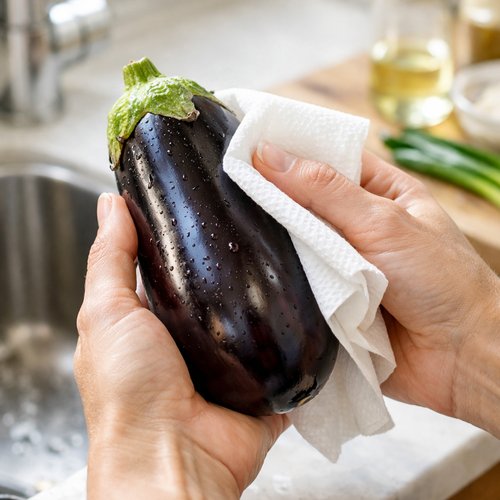
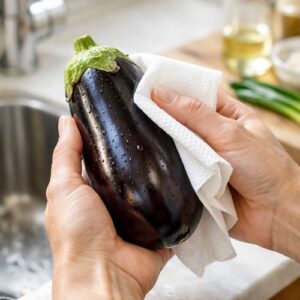
Begin by rinsing your eggplant under cool water and patting it completely dry with paper towels. Moisture is eggplant’s enemy when you’re trying to get it golden, so don’t skip this. Now, trim off about ½ inch from each end of the eggplant with your sharp knife. Stand the eggplant upright on your cutting board and slice it on a diagonal—about a 45-degree angle—into pieces roughly 1 inch thick. The diagonal cut gives you more surface area for browning and looks beautiful on the plate. Don’t worry if your angles aren’t perfect; they’re all going to taste the same.
Place your eggplant pieces into a microwave-safe bowl and cover them with cold water until just submerged. Microwave on high for 1 minute, then stop and check. Open the microwave, poke a piece gently with a fork—it should give slightly but still hold its shape. If it’s still very firm, microwave for another 30 seconds and check again. The goal is tender-but-not-mushy, which should take about 1 to 1½ minutes total. This pre-cooking step is crucial; it removes excess moisture and ensures your eggplant will brown beautifully instead of steam. Drain the eggplant in a colander and pat every piece completely dry with paper towels. Set aside on a clean plate.
Step 2: Make Your Sauce While the Eggplant Rests
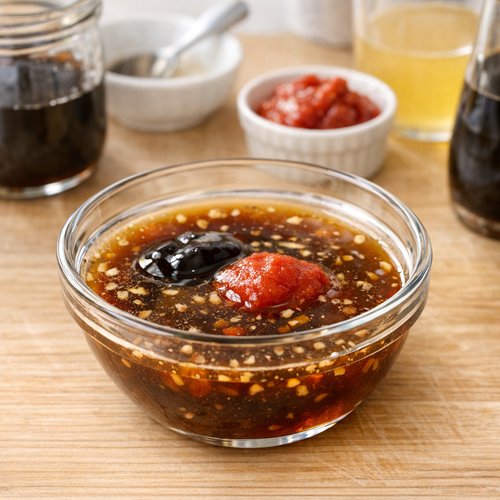
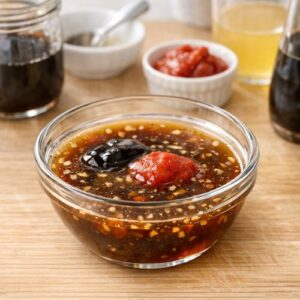
Get a small bowl and add your ½ cup low-sodium chicken broth, ¼ cup soy sauce, 1 tablespoon oyster sauce, 1 tablespoon rice vinegar, 1 teaspoon tomato paste, 1 teaspoon sesame oil, 1 tablespoon sambal oelek, and ½ teaspoon brown sugar. Use a whisk or fork to combine everything until the tomato paste breaks down and the mixture looks uniform. Now comes the critical part: sprinkle ½ teaspoon cornstarch over the top and whisk it in thoroughly. You should see no little white specks of undissolved cornstarch floating around. This will thicken your sauce perfectly without making it gluey. Set the sauce bowl aside. Don’t cook it yet; you’ll add it at the very end.
Step 3: Prepare All Your Vegetables and Aromatics (Your Mise en Place)
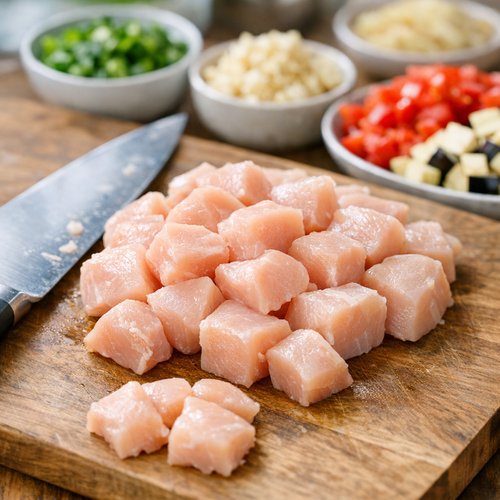
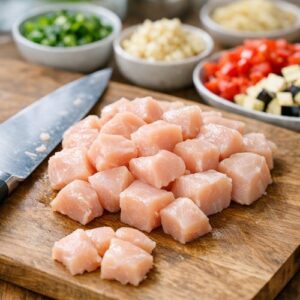
This is the step that makes you feel like a real cook. Get your sharp knife and cutting board ready. Cut your chicken breast into cubes about ¾ inch on each side—like dice, but you’re not aiming for perfection. Even if some pieces are slightly larger or smaller, they’ll still cook beautifully because you’re keeping an eye on them. Season the chicken pieces generously with salt and pepper, then set aside on a plate.
Now chop your aromatics: mince your 2 cloves of garlic into tiny pieces (roughly ⅛ inch or smaller), finely chop your shallot (cut it in half, then slice thinly, then chop across—should give you about ¼ cup), and mince your fresh ginger by peeling it with a spoon and then chopping finely. Chop your bell pepper into pieces about ½ inch across—they don’t need to be perfect. Slice your shiitake mushrooms about ¼ inch thick, and chop your green onions into 1-inch pieces, keeping the white parts separate from the green parts. Put all of these in one bowl together—your aromatics and vegetable prep bowl. This organization prevents panic mid-cooking.
Step 4: Cook Your Chicken Until Golden (But Not Fully Cooked)
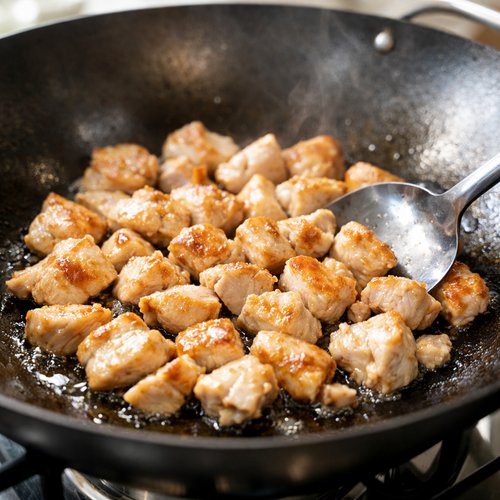
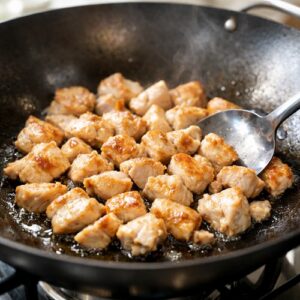
Place your large wok or skillet on the stove over medium-high heat. Add 1 tablespoon of canola oil and let it heat for about 1 minute. You’ll know it’s ready when a small piece of chicken sizzles immediately when it touches the pan. Carefully add your seasoned chicken pieces in a single layer and let them sit undisturbed for about 2 minutes. Don’t stir. You want them to develop a golden crust on the bottom. After 2 minutes, use a wooden spoon or spatula to turn each piece over and cook the other side for another 2 minutes until it’s golden brown too. The chicken won’t be fully cooked through yet—that’s intentional. It’ll finish cooking when everything comes back together. Transfer the chicken to a clean plate and set aside.
The pan stays on the heat. Don’t wipe it out; all those browned bits are pure flavor.
Step 5: Brown Your Eggplant Until It’s Silky and Golden
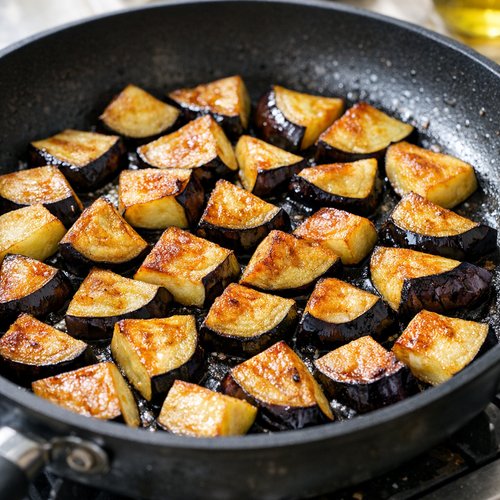
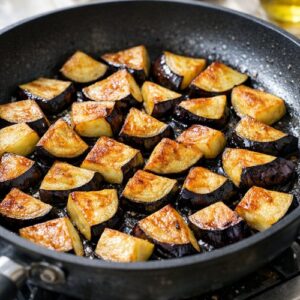
Your pan is still hot. Arrange your dried eggplant pieces in a single layer across the bottom. This is important—if they overlap, they’ll steam instead of fry. You might need to work in batches if your pan isn’t large enough. Let them sit undisturbed for about 2 minutes. You should hear a gentle sizzle. Peek underneath one piece; if the underside is light golden brown, flip all the pieces. Cook the other side for another 2 minutes. The eggplant should look slightly caramelized and feel tender when you press it with your spoon. Remove all the eggplant to a clean plate and set aside.
Step 6: Sauté Your Aromatics and Build Flavor
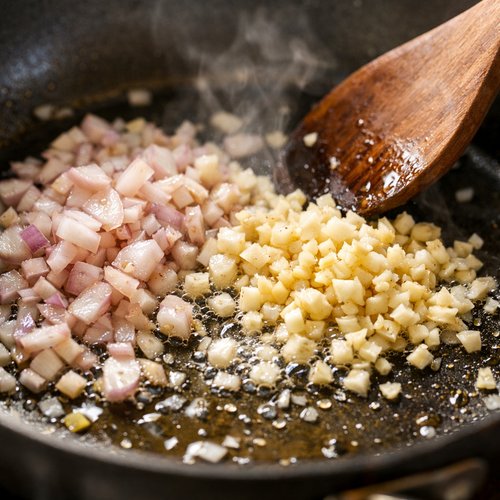
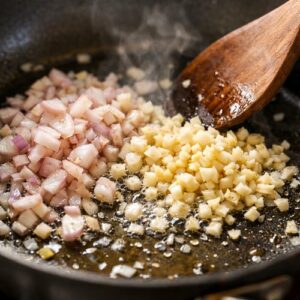
Add your remaining 1 tablespoon of canola oil to the pan (it’s still on medium-high heat). Immediately add your minced garlic and chopped shallots and cook for about 1 minute, stirring constantly. This is when the kitchen smells incredible—that’s the signal you’re doing it right. When the shallots look slightly translucent and soft, add your bell pepper pieces and cook for another 2-3 minutes, stirring occasionally, until they’re just beginning to soften but still have a little bite to them. Add your ginger, green onion whites, and sliced mushrooms and cook for another 3 minutes, stirring gently.
Step 7: Bring Everything Together and Finish
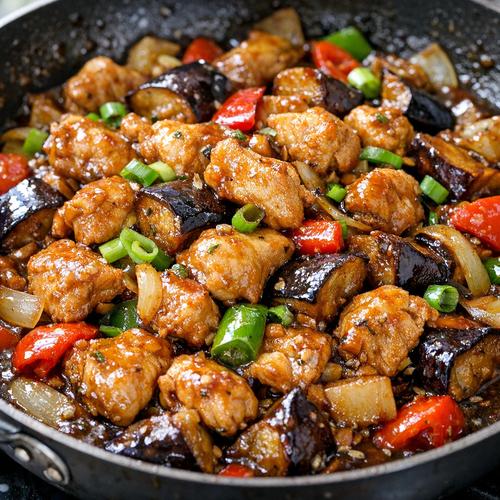
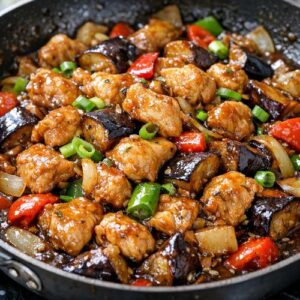
This is the final moment. Your pan has all those beautiful sautéed vegetables, and you’re going to bring back the chicken and eggplant. Give your sauce bowl a quick stir (cornstarch can settle), then pour it slowly into the pan while stirring gently. You’ll watch the liquid transform almost immediately into a glossy, silky glaze. Add back your cooked chicken pieces and your eggplant and gently fold everything together for about 3-5 minutes until the sauce thickens and coats everything beautifully. The cornstarch will do its job; you’ll see the sauce go from thin and liquidy to glossy and coating.
Remove from heat. Taste a piece of chicken and a piece of eggplant. They should be tender and fully cooked. The sauce should coat your spoon. If it’s still too thin, let the residual heat do a bit more thickening as you serve.
Step 8: Plate and Serve
Spoon your rice into shallow bowls or onto plates. Ladle the chicken and eggplant mixture over the rice, making sure everyone gets plenty of sauce. Garnish with the green parts of your green onions for color and freshness. Serve immediately while everything is warm.
How to Tell If You Did It Right
Let me give you the specific signs that tell you when you’ve nailed each stage. This takes the guesswork out of cooking.
- The eggplant should be silky inside with a light golden-brown exterior – When you bite into a piece, it should yield immediately without resistance. If it’s mushy, you over-microwaved it (next time cut it back to 1 minute). If it’s still firm, you under-cooked it in the wok (cook the second side another minute or two).
- The chicken should be white throughout with no pink – Cut into the thickest piece; if you see pink, it needs another minute or two in the pan at the end. The internal temperature should be 165°F (74°C) if you have a meat thermometer.
- The sauce should coat a spoon like warm honey – Dip your spoon in and run your finger across the back. If the sauce drips right off, it needs another minute to thicken. If it barely moves, it’s perfect.
- Everything should smell deeply savory with a hint of heat and sweetness – That aroma tells you the flavors are balanced. If it smells too salty, you’ve used too much soy sauce (but it’s okay—it’s still delicious). If it smells sharp and acidic, you’ve added too much rice vinegar (next time, use less).
What Went Wrong? Beginner Fixes
Cooking is learning, and every mistake teaches you something. Here are the most common things that happen on a first attempt and exactly how to fix them.
- Your eggplant is soggy, not golden – This happens when you don’t pat it dry enough after microwaving, or when you crowd the pan. Next time: use paper towels more aggressively to get all moisture off, and cook eggplant in a single layer. If this happens now, it’s still edible; just know the texture will be softer than ideal. It still tastes wonderful.
- Your sauce is too salty – You might have added extra soy sauce, or your broth was already high in sodium. The fix: add ¼ cup more rice vinegar and ½ teaspoon brown sugar to balance it. Or add a squeeze of fresh lemon juice, which my grandmother swore by.
- Your chicken is dry – You cooked it through in Step 4, then again in Step 7. Next time, brown it for only 2 minutes on each side in Step 4. But if this happened now, it’s a learning moment. Slice it thinner next time, or cut the pieces smaller.
- Your sauce is too thin – The cornstarch didn’t thicken properly, usually because it wasn’t fully dissolved in Step 2. If this is happening now, whisk 1 teaspoon cornstarch with 2 tablespoons cold water, then stir it into the pan with everything off the heat. Let it sit for a minute and it’ll thicken beautifully.
- You forgot to add the sauce – This happens. If you’ve already combined everything, just whisk your sauce and pour it over the hot mixture, then stir gently for 2 minutes. It’ll come together.
Your Next Steps After Mastering This
Once you’ve made this dish two or three times, you’ve learned something profound: how to manage heat, how to prep vegetables efficiently, and how to build a sauce from scratch. These skills transfer everywhere. You now know how to cook protein and vegetables separately before combining them, which is the foundation of stir-frying. You understand how cornstarch thickens, so you can apply that knowledge to gravies, pan sauces, and soups. You’ve practiced the rhythm of aromatics—garlic and ginger first, then vegetables, then sauce—and that sequence appears in hundreds of dishes.
Next, try our Asian Beef Shank Recipe, which teaches you low-and-slow braising using similar sauce principles but with more time and deeper flavor. Or explore our Bao Recipe Filling, which uses the same stir-fried technique inside dumpling dough. Both build on what you’ve learned here.
Expert’s Nutritional Insight: Why This Dish Is Balanced
As a registered dietitian, I want you to understand why my grandmother’s approach to this dish was nutritionally brilliant, even if she wasn’t thinking in those terms. The eggplant is a cruciferous vegetable rich in fiber and antioxidants, particularly nasunin, which supports brain health. The shiitake mushrooms contain beta-glucans that support immune function, and the fresh ginger aids digestion while reducing inflammation. The chicken breast provides lean protein (roughly 35g per serving), and the brown rice adds complex carbohydrates and B vitamins.
What makes this truly balanced is the proportion: roughly 1 part protein, 2 parts vegetables, and 1 part grain. According to USDA dietary guidelines, this aligns perfectly with the MyPlate model. The sauce, despite using soy sauce, stays low in sodium because we’re using low-sodium versions and balancing with rice vinegar and sambal, which add flavor without excess salt. My grandmother understood intuitively that food should nourish you completely—body, mind, and spirit.
Can I Store Chicken Eggplant Chinese Recipe?
Yes, and it actually improves after a day as the flavors deepen. Store in an airtight container in the refrigerator for up to 4 days. The eggplant will soften slightly, but that’s okay—it becomes even more tender. When you reheat, warm gently over low heat in a skillet or in the microwave (covered) for 3-4 minutes, stirring occasionally. The sauce might thicken a bit more as it sits, which is perfect.
For freezing: I recommend freezing just the chicken, vegetables, and sauce together (without the rice) in a freezer-safe container for up to 3 months. Rice becomes grainy when frozen and thawed, so it’s better to cook fresh rice when you reheat. To defrost, move it to the refrigerator overnight, then reheat gently on the stovetop.
Make-Ahead Guide for Busy Weeknights
You can do most of the prep work hours in advance, which makes dinnertime feel effortless. Up to 8 hours ahead, chop all your vegetables and aromatics, place them together in one container, cover, and refrigerate. Prepare your sauce in its bowl, cover, and refrigerate separately. When you’re ready to cook, simply take out your prep and your chicken, and you’re cooking in 15 minutes.
The morning of: Cut and prep your eggplant, microwave it, pat it dry, and store on a paper-towel-lined plate covered loosely with plastic wrap in the refrigerator. This saves you 5 minutes during cooking and means one less thing to think about.
The day before: Cook your rice, store it in the refrigerator, and reheat gently with a splash of water just before serving. This is a game-changer for meal planning.
Seasonal Variations: How to Adapt This Year-Round
My grandmother’s kitchen changed with the seasons, and so should yours. This recipe is flexible enough to evolve.
Summer (June-August): Use lighter touch. Reduce the sambal oelek to ½ teaspoon since summer heat makes people crave less heat. Add fresh corn kernels (about ¾ cup) in Step 6 after the mushrooms. Serve with jasmine rice instead of brown rice for a lighter feel.
Fall (September-November): Add ½ teaspoon five-spice powder to the sauce for warm spice notes. Include sliced Kabocha squash (pre-microwaved like the eggplant) alongside the eggplant for earthiness. This is my favorite season for this dish.
Winter (December-February): Increase the sambal oelek to 1½ teaspoons for extra warmth and comfort. Add 2 tablespoons of black garlic (optional but wonderful) for depth. Serve with white rice instead of brown for more comfort-food feeling. My grandmother would add extra ginger too.
Spring (March-May): Use fresh peas (about ¾ cup, added in Step 6) and tender baby bok choy (halved lengthwise, added with the mushrooms) for brightness. Reduce the sauce by 2 tablespoons of broth to keep things lighter. Add 1 tablespoon of white miso to the sauce for umami complexity.
Nutrition Information
Based on USDA nutritional database analysis, per serving (serves 4):
- Calories: 385
- Protein: 35g (from the chicken breast and mushrooms)
- Total Fat: 12g (mostly from the cooking oil and sesame oil)
- Saturated Fat: 2g
- Carbohydrates: 38g (from the rice and vegetables)
- Fiber: 4g (from the eggplant and mushrooms)
- Sodium: 680mg (using low-sodium broth and soy sauce)
- Sugars: 4g (naturally occurring from vegetables and brown sugar in sauce)
This is a well-balanced dinner that provides sustained energy without excess calories. The protein-to-carbohydrate ratio supports muscle maintenance while the fiber aids digestion. If you have sodium restrictions, use even lower-sodium soy sauce (many brands now offer “reduced-sodium” versions with 25% less salt).
What Can I Serve With Chicken Eggplant Chinese Recipe?
This dish stands beautifully on its own with rice, but here are some complementary sides if you’d like to expand the meal.
- Steamed or stir-fried green vegetables – Bok choy, gai lan, or broccoli with a touch of sesame oil adds freshness and color without competing for attention.
- A simple cucumber salad with rice vinegar dressing – The coolness and acidity cut through the richness of the sauce beautifully. Slice cucumbers thin, dress with 2 tablespoons rice vinegar, 1 teaspoon sesame oil, salt, and a pinch of sugar.
- Egg drop soup or miso soup – A warm, light broth before or alongside the main course aids digestion. Try our Banh Mi Burger Recipe if you want something with more substance and Vietnamese flavor.
- Fresh fruit for dessert – Mandarin oranges, lychees, or pineapple provide brightness. Skip heavy desserts after this rich, satisfying main course.

Chicken Eggplant Chinese Recipe
Ingredients
Method
- Begin by rinsing your eggplant under cool water and patting it completely dry with paper towels. Moisture is eggplant's enemy when you're trying to get it golden, so don't skip this. Now, trim off about ½ inch from each end of the eggplant with your sharp knife. Stand the eggplant upright on your cutting board and slice it on a diagonal—about a 45-degree angle—into pieces roughly 1 inch thick. The diagonal cut gives you more surface area for browning and looks beautiful on the plate. Don't worry if your angles aren't perfect; they're all going to taste the same. Place your eggplant pieces into a microwave-safe bowl and cover them with cold water until just submerged. Microwave on high for 1 minute, then stop and check. Open the microwave, poke a piece gently with a fork—it should give slightly but still hold its shape. If it's still very firm, microwave for another 30 seconds and check again. The goal is tender-but-not-mushy, which should take about 1 to 1½ minutes total. This pre-cooking step is crucial; it removes excess moisture and ensures your eggplant will brown beautifully instead of steam. Drain the eggplant in a colander and pat every piece completely dry with paper towels. Set aside on a clean plate.
- Get a small bowl and add your ½ cup low-sodium chicken broth, ¼ cup soy sauce, 1 tablespoon oyster sauce, 1 tablespoon rice vinegar, 1 teaspoon tomato paste, 1 teaspoon sesame oil, 1 tablespoon sambal oelek, and ½ teaspoon brown sugar. Use a whisk or fork to combine everything until the tomato paste breaks down and the mixture looks uniform. Now comes the critical part: sprinkle ½ teaspoon cornstarch over the top and whisk it in thoroughly. You should see no little white specks of undissolved cornstarch floating around. This will thicken your sauce perfectly without making it gluey. Set the sauce bowl aside. Don't cook it yet; you'll add it at the very end.
- This is the step that makes you feel like a real cook. Get your sharp knife and cutting board ready. Cut your chicken breast into cubes about ¾ inch on each side—like dice, but you're not aiming for perfection. Even if some pieces are slightly larger or smaller, they'll still cook beautifully because you're keeping an eye on them. Season the chicken pieces generously with salt and pepper, then set aside on a plate. Now chop your aromatics: mince your 2 cloves of garlic into tiny pieces (roughly ⅛ inch or smaller), finely chop your shallot (cut it in half, then slice thinly, then chop across—should give you about ¼ cup), and mince your fresh ginger by peeling it with a spoon and then chopping finely. Chop your bell pepper into pieces about ½ inch across—they don't need to be perfect. Slice your shiitake mushrooms about ¼ inch thick, and chop your green onions into 1-inch pieces, keeping the white parts separate from the green parts. Put all of these in one bowl together—your aromatics and vegetable prep bowl. This organization prevents panic mid-cooking.
- Place your large wok or skillet on the stove over medium-high heat. Add 1 tablespoon of canola oil and let it heat for about 1 minute. You'll know it's ready when a small piece of chicken sizzles immediately when it touches the pan. Carefully add your seasoned chicken pieces in a single layer and let them sit undisturbed for about 2 minutes. Don't stir. You want them to develop a golden crust on the bottom. After 2 minutes, use a wooden spoon or spatula to turn each piece over and cook the other side for another 2 minutes until it's golden brown too. The chicken won't be fully cooked through yet—that's intentional. It'll finish cooking when everything comes back together. Transfer the chicken to a clean plate and set aside. The pan stays on the heat. Don't wipe it out; all those browned bits are pure flavor.
- Your pan is still hot. Arrange your dried eggplant pieces in a single layer across the bottom. This is important—if they overlap, they'll steam instead of fry. You might need to work in batches if your pan isn't large enough. Let them sit undisturbed for about 2 minutes. You should hear a gentle sizzle. Peek underneath one piece; if the underside is light golden brown, flip all the pieces. Cook the other side for another 2 minutes. The eggplant should look slightly caramelized and feel tender when you press it with your spoon. Remove all the eggplant to a clean plate and set aside.
- Add your remaining 1 tablespoon of canola oil to the pan (it's still on medium-high heat). Immediately add your minced garlic and chopped shallots and cook for about 1 minute, stirring constantly. This is when the kitchen smells incredible—that's the signal you're doing it right. When the shallots look slightly translucent and soft, add your bell pepper pieces and cook for another 2-3 minutes, stirring occasionally, until they're just beginning to soften but still have a little bite to them. Add your ginger, green onion whites, and sliced mushrooms and cook for another 3 minutes, stirring gently.
- This is the final moment. Your pan has all those beautiful sautéed vegetables, and you're going to bring back the chicken and eggplant. Give your sauce bowl a quick stir (cornstarch can settle), then pour it slowly into the pan while stirring gently. You'll watch the liquid transform almost immediately into a glossy, silky glaze. Add back your cooked chicken pieces and your eggplant and gently fold everything together for about 3-5 minutes until the sauce thickens and coats everything beautifully. The cornstarch will do its job; you'll see the sauce go from thin and liquidy to glossy and coating. Remove from heat. Taste a piece of chicken and a piece of eggplant. They should be tender and fully cooked. The sauce should coat your spoon. If it's still too thin, let the residual heat do a bit more thickening as you serve.
- Spoon your rice into shallow bowls or onto plates. Ladle the chicken and eggplant mixture over the rice, making sure everyone gets plenty of sauce. Garnish with the green parts of your green onions for color and freshness. Serve immediately while everything is warm.
Notes
FAQs
Can I use Italian eggplant instead of Chinese purple eggplant?
You can, but the results will be slightly different. Italian eggplant is larger and contains more seeds, which can make it a bit watery even after microwaving. If that’s all you have, microwave it for 2 minutes instead of 1½, and pat it extra dry. It’ll still be delicious, just with a slightly softer texture.
What if I don’t have sambal oelek? What’s the best substitute?
Sriracha works in a pinch (use 1 tablespoon instead of the sambal oelek), but it’s thinner and slightly sweeter. Red pepper flakes (½ teaspoon) plus 1 teaspoon tomato paste can replace it, though you’ll lose some of the chile complexity. My favorite alternative is gochugaru (Korean red pepper flakes), which has a similar fruity heat. Use ½ teaspoon mixed into the sauce.
Can I make this with thighs instead of breast meat?
Absolutely, and many cooks prefer it. Thighs are more forgiving and stay juicier. You’ll need about 1¾ pounds of boneless, skinless thighs (they’re fattier than breast, so use slightly more weight). Cook them the same way, but give them an extra 2 minutes in Step 7 to ensure they’re cooked through. The sauce will taste richer with thigh meat.
Is there any way to make this vegan or vegetarian?
Yes. Replace the chicken with 1½ pounds of firm or extra-firm tofu, pressed to remove excess moisture and cubed. Follow all the same steps—it browns beautifully. You can also add an additional 1 cup of vegetables (snap peas, baby corn, or bamboo shoots work wonderfully—check our Bamboo Sprouts Recipe for inspiration). Replace the chicken broth with vegetable broth. The rest stays exactly the same. The flavor is just as rich and satisfying.
How do I know if my sauce has the right consistency?
Dip a spoon into the sauce and hold it horizontally. Tilt it slightly. If the sauce runs off immediately, it needs another 30 seconds to thicken. If it clings to the spoon and moves slowly, it’s perfect. If it barely moves at all, you might have used too much cornstarch (but it’s still edible—serve it over rice). On your next try, reduce the cornstarch to ¼ teaspoon and whisk in ½ teaspoon if needed.
Can I use frozen chicken breast?
Yes, but thaw it completely in the refrigerator overnight first. Never use frozen chicken in this recipe because it won’t brown properly in Step 4. Frozen chicken releases too much water into the pan,